Luxafor () is a brand of office productivity tools designed to improve efficiency and communication in workplaces. The brands main product is LED status indicators for use in office settings. Luxafor is a product line under the company SIA Greynut, based in Riga, Latvia. == History == Luxafor was developed by the technology company SIA Greynut. The brand first gained attention through a Kickstarter campaign in 2015, which aimed to fund its initial product, the Luxafor Flag. Although the campaign was unsuccessful in reaching its funding goal, the product was still brought to market. In 2017, Luxafor launched another Kickstarter campaign for the Luxafor Bluetooth, a wireless version of its LED status indicator. This campaign also did not meet its funding goal, but like its predecessor, the product was still developed and released. Despite initial setbacks, Luxafor Bluetooth has become one of the brand's leading products. == Products == Luxafors main product range is LED status indicators, including: === Luxafor Flag === A USB-powered LED indicator that shows different colors to signal the user's availability. === Luxafor Bluetooth === A wireless LED indicator controlled via Bluetooth, integrating with productivity tools like Slack and Microsoft Teams. === Luxafor Switch === An advanced status indicator designed to manage room and workspace availability. === Other === Other Luxafor products include CO2 Dongle, Smart Button, Mute Button, Pomodoro Timer and others. == Features == Luxafor products are known for their customizable indicators, integration capabilities with IFTTT, Zapier, and remote control features. They are compatible with various operating systems, including Windows and macOS, and can be integrated with numerous communication and productivity platforms, like Microsoft Teams and Cisco Jabber.
Software agent
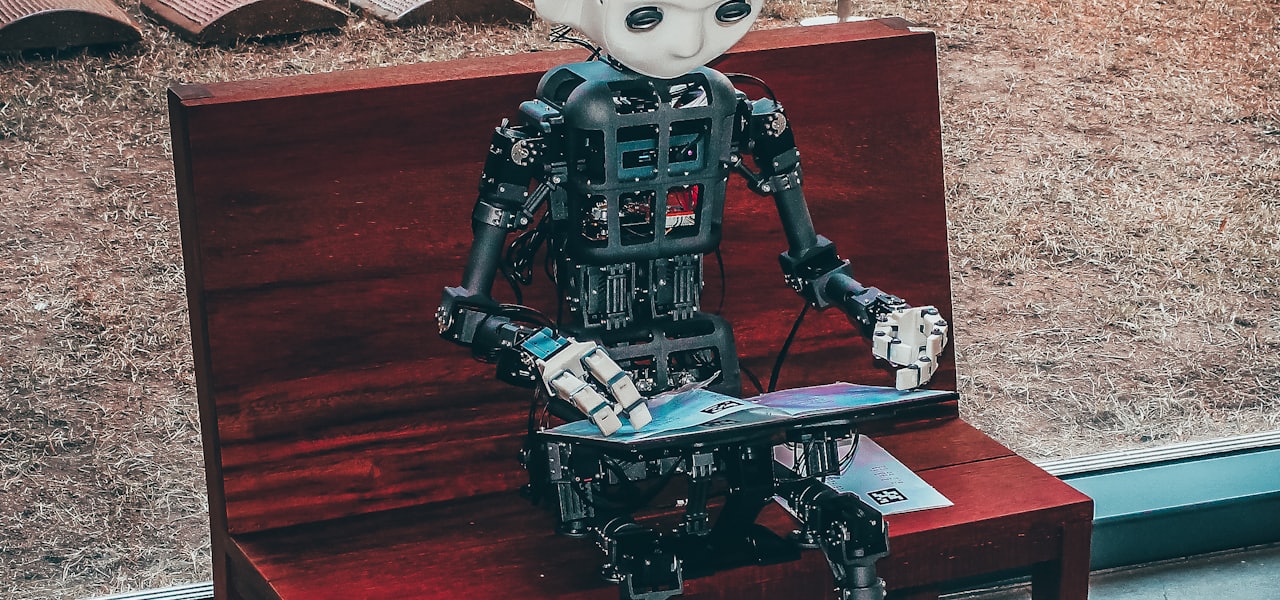
In computer science, a software agent is a computer program that acts for a user or another program in a relationship of agency. The term agent is derived from the Latin agere (to do): an agreement to act on one's behalf. Such "action on behalf of" implies the authority to decide which, if any, action is appropriate. Some agents are colloquially known as bots, from robot. They may be embodied, as when execution is paired with a robot body, or as software such as a chatbot executing on a computer, such as a mobile device, e.g. Siri. Software agents may be autonomous or work together with other agents or people. Software agents interacting with people (e.g. chatbots, human-robot interaction environments) may possess human-like qualities such as natural language understanding and speech, personality or embody humanoid form (see Asimo). Related and derived concepts include intelligent agents (in particular exhibiting some aspects of artificial intelligence, such as reasoning), autonomous agents (capable of modifying the methods of achieving their objectives), distributed agents (being executed on physically distinct computers), multi-agent systems (distributed agents that work together to achieve an objective that could not be accomplished by a single agent acting alone), and mobile agents (agents that can relocate their execution onto different processors). == Concepts == The basic attributes of an autonomous software agent are that agents: are not strictly invoked for a task, but activate themselves, may reside in wait status on a host, perceiving context, may get to run status on a host upon starting conditions, do not require interaction of user, may invoke other tasks including communication. The concept of an agent provides a method of describing a complex software entity that is capable of acting with a certain degree of autonomy in order to accomplish tasks on behalf of its host. But unlike objects, which are defined in terms of methods and attributes, an agent is defined in terms of its behavior. Various authors have proposed different definitions of agents, these commonly include concepts such as: persistence: code is not executed on demand but runs continuously and decides for itself when it should perform some activity; autonomy: agents have capabilities of task selection, prioritization, goal-directed behavior, decision-making without human intervention; social ability: agents are able to engage other components through some sort of communication and coordination, they may collaborate on a task; reactivity: agents perceive the context in which they operate and react to it appropriately. === Distinguishing agents from programs === All agents are programs, but not all programs are agents. Contrasting the term with related concepts may help clarify its meaning. Franklin & Graesser (1997) discuss four key notions that distinguish agents from arbitrary programs: reaction to the environment, autonomy, goal-orientation and persistence. === Intuitive distinguishing agents from objects === Agents are more autonomous than objects. Agents have flexible behavior: reactive, proactive, social. Agents have at least one thread of control but may have more. === Distinguishing agents from expert systems === Expert systems are not coupled to their environment. Expert systems are not designed for reactive, proactive behavior. Expert systems do not consider social ability. === Distinguishing intelligent software agents from intelligent agents in AI === Intelligent agents (also known as rational agents) are not just computer programs: they may also be machines, human beings, communities of human beings (such as firms) or anything that is capable of goal-directed behavior. == Impact of software agents == Software agents may offer various benefits to their end users by automating complex or repetitive tasks. However, there are organizational and cultural impacts of this technology that need to be considered prior to implementing software agents. === Organizational impact === === Work contentment and job satisfaction impact === People like to perform easy tasks providing the sensation of success unless the repetition of the simple tasking is affecting the overall output. In general implementing software agents to perform administrative requirements provides a substantial increase in work contentment, as administering their own work does never please the worker. The effort freed up serves for a higher degree of engagement in the substantial tasks of individual work. Hence, software agents may provide the basics to implement self-controlled work, relieved from hierarchical controls and interference. Such conditions may be secured by application of software agents for required formal support. === Cultural impact === The cultural effects of the implementation of software agents include trust affliction, skills erosion, privacy attrition and social detachment. Some users may not feel entirely comfortable fully delegating important tasks to software applications. Those who start relying solely on intelligent agents may lose important skills, for example, relating to information literacy. In order to act on a user's behalf, a software agent needs to have a complete understanding of a user's profile, including his/her personal preferences. This, in turn, may lead to unpredictable privacy issues. When users start relying on their software agents more, especially for communication activities, they may lose contact with other human users and look at the world with the eyes of their agents. These consequences are what agent researchers and users must consider when dealing with intelligent agent technologies. === History === The concept of an agent can be traced back to Hewitt's Actor Model (Hewitt, 1977) - "A self-contained, interactive and concurrently-executing object, possessing internal state and communication capability." To be more academic, software agent systems are a direct evolution of Multi-Agent Systems (MAS). MAS evolved from Distributed Artificial Intelligence (DAI), Distributed Problem Solving (DPS) and Parallel AI (PAI), thus inheriting all characteristics (good and bad) from DAI and AI. John Sculley's 1987 "Knowledge Navigator" video portrayed an image of a relationship between end-users and agents. Being an ideal first, this field experienced a series of unsuccessful top-down implementations, instead of a piece-by-piece, bottom-up approach. The range of agent types is now (from 1990) broad: WWW, search engines, etc. == Examples of intelligent software agents == === Buyer agents (shopping bots) === Buyer agents travel around a network (e.g. the internet) retrieving information about goods and services. These agents, also known as 'shopping bots', work very efficiently for commodity products such as CDs, books, electronic components, and other one-size-fits-all products. Buyer agents are typically optimized to allow for digital payment services used in e-commerce and traditional businesses. === User agents (personal agents) === User agents, or personal agents, are intelligent agents that take action on your behalf. In this category belong those intelligent agents that already perform, or will shortly perform, the following tasks: Check your e-mail, sort it according to the user's order of preference, and alert you when important emails arrive. Play computer games as your opponent or patrol game areas for you. Assemble customized news reports for you. There are several versions of these, including CNN. Find information for you on the subject of your choice. Fill out forms on the Web automatically for you, storing your information for future reference Scan Web pages looking for and highlighting text that constitutes the "important" part of the information there Discuss topics with you ranging from your deepest fears to sports Facilitate with online job search duties by scanning known job boards and sending the resume to opportunities who meet the desired criteria Profile synchronization across heterogeneous social networks === Monitoring-and-surveillance (predictive) agents === Monitoring and surveillance agents are used to observe and report on equipment, usually computer systems. The agents may keep track of company inventory levels, observe competitors' prices and relay them back to the company, watch stock manipulation by insider trading and rumors, etc. For example, NASA's Jet Propulsion Laboratory has an agent that monitors inventory, planning, schedules equipment orders to keep costs down, and manages food storage facilities. These agents usually monitor complex computer networks that can keep track of the configuration of each computer connected to the network. A special case of monitoring-and-surveillance agents are organizations of agents used to automate decision-making process during tactical operations. The agents monitor the status of assets (ammunition, weapons available, platforms for transport, etc.) and receive goals from hi
Automated parking system
An automated (car) parking system (APS) is a mechanical system designed to minimize the area and/or volume required for parking cars. Like a multi-story parking garage, an APS provides parking for cars on multiple levels stacked vertically to maximize the number of parking spaces while minimizing land usage. The APS, however, utilizes a mechanical system to transport cars to and from parking spaces (rather than the driver) in order to eliminate much of the space wasted in a multi-story parking garage. While a multi-story parking garage is similar to multiple parking lots stacked vertically, an APS is more similar to an automated storage and retrieval system for cars. Parking systems are generally powered by electric motors or hydraulic pumps that move vehicles into a storage position.The paternoster (shown animated at the right) is an example of one of the earliest and most common types of APS. APS are also generically known by a variety of other names, including:automated parking facility (APF), automated vehicle storage and retrieval system (AVSRS), car parking system, mechanical parking, and robotic parking garage. == History == The concept for the automated parking system was and is driven by two factors: a need for parking spaces and a scarcity of available land. The earliest use of an APS was in Paris, France in 1905 at the Garage Rue de Ponthieu. The APS consisted of a groundbreaking multi-story concrete structure with an internal car elevator to transport cars to upper levels where attendants parked the cars. In the 1920s, a Ferris wheel-like APS (for cars rather than people) called a paternoster system became popular as it could park eight cars in the ground space normally used for parking two cars. Mechanically simple with a small footprint, the paternoster was easy to use in many places, including inside buildings. At the same time, Kent Automatic Garages was installing APS with capacities exceeding 1,000 cars. The “ferris-wheel,” or paternoster system — was created by the Westinghouse Corporation in 1923 and subsequently built in 1932 on Chicago's Monroe Street. The Nash Motor Company created the first glass-enclosed version of this system for the Chicago Century of Progress Exhibition in 1933 The first driverless parking garage opened in 1951 in Washington, D.C., but was replaced with office space due to increasing land values. APS saw a spurt of interest in the U.S. in the late 1940s and 1950s with the Bowser, Pigeon Hole and Roto Park systems. In 1957, 74 Bowser, Pigeon Hole systems were installed, and some of these systems remain in operation. However, interest in APS in the U.S. waned due to frequent mechanical problems and long waiting times for patrons to retrieve their cars. In the United Kingdom, the Auto Stacker opened in 1961 in Woolwich, south east London, but proved equally difficult to operate. Interest in APS in the U.S. was renewed in the 1990s, and there were 25 major current and planned APS projects (representing nearly 6,000 parking spaces) in 2012. The first American robotic parking garage opened in 2002 in Hoboken, New Jersey. While interest in the APS in the U.S. languished until the 1990s, Europe, Asia and Central America had been installing more technically advanced APS since the 1970s. In the early 1990s, nearly 40,000 parking spaces were being built annually using the paternoster APS in Japan. In 2012, there are an estimated 1.6 million APS parking spaces in Japan. The ever-increasing scarcity of available urban land (urbanization) and increase of the number of cars in use (motorization) have combined with sustainability and other quality-of-life issues to renew interest in APS as alternatives to multi-storey car parks, on-street parking, and parking lots. == Largest systems == The largest Automated Parking Facility in the world is in Al Jahra, Kuwait, and provides 2,314 parking spaces. The world's fastest Automated Parking System is in Wolfsburg, Germany, with a retrieval time of 1 minute and 44 seconds. The largest APS in Europe is at Dokk1 in Aarhus, Denmark, and provides 1,000 parking spaces via 20 car lifts. == Space saving == All APS take advantage of a common concept to decrease the area of parking spaces - removing the driver and passengers from the car before it is parked. With either fully automated or semi-automated APS, the car is driven up to an entry point to the APS and the driver and passengers exit the car. The car is then moved automatically or semi-automatically (with some attendant action required) to its parking space. The space-saving provided by the APS, compared to the multi-story parking garage, is derived primarily from a significant reduction in space not directly related to the parking of the car: Parking space width and depth (and distances between parking spaces) are dramatically reduced since no allowance need be made for driving the car into the parking space or for the opening of car doors (for drivers and passengers) No driving lanes or ramps are needed to drive the car to/from the entrance/exit to a parking space Ceiling height is minimized since there is no pedestrian traffic (drivers and passengers) in the parking area, and No walkways, stairways or elevators are needed to accommodate pedestrians in the parking area. With the elimination of ramps, driving lanes, pedestrians and the reduction in ceiling heights, the APS requires substantially less structural material than the multi-story parking garage. Many APS utilize a steel framework (some use thin concrete slabs) rather than the monolithic concrete design of the multi-story parking garage. These factors contribute to an overall volume reduction and further space savings for the APS. == Other considerations == In addition to the space saving, many APS designs provide a number of secondary benefits: The parked cars and their contents are more secure since there is no public access to parked cars Minor parking lot damage such as scrapes and dents are eliminated Drivers and passengers are safer not having to walk through parking lots or garages Driving around in search of a parking space is eliminated, thereby reducing engine emissions and wasted time Only minimal ventilation and lighting systems are needed Handicap access is improved The volume and visual impact of the parking structure is minimized Shorter construction time === Problems === There have been a number of problems with robotic parking systems, particularly in the United States. The systems work well in balanced throughput situations like shopping malls and train stations, but they are unsuited to high peak volume applications like rush hour usage or stadiums and they suffer from technical problems. Further, parkers not familiar with the system may cause problems, for example by failing to push the button to alert a fully automated system to the presence of a car to be parked. In London around 40 vehicles were trapped for two years in CBRE's system. == Fully automated vs semi-automated == Fully automated parking systems operate much like robotic valet parking. The driver drives the car into an APS entry (transfer) area. The driver and all passengers exit the car. The driver uses an automated terminal nearby for payment and receipt of a ticket. When driver and passengers have left the entry area, the mechanical system lifts the car and transports it to a pre-determined parking space in the system. More sophisticated fully automated APS will obtain the dimensions of cars on entry in order to place them in the smallest available parking space. The driver retrieves a car by inserting a ticket or code into an automated terminal. The APS lifts the car from its parking space and delivers it to an exit area. Most often, the retrieved car has been oriented to eliminate the need for the driver to back out. Fully automated APS theoretically eliminate the need for parking attendants. Semi-automated APS also use a mechanical system of some type to move a car to its parking space, however putting the car into and/or the operation of the system requires some action by an attendant or the driver. The choice between fully and semi-automated APS is often a matter of space and cost, however large capacity (> 100 cars) tend to be fully automated. == Applications == By virtue of their relatively smaller volume and mechanized parking systems, APS are often used in locations where a multi-story parking garage would be too large, too costly or impractical. Examples of such applications include, under or inside existing or new structures, between existing structures and in irregularly shaped areas. APS can also be applied in situations similar to multi-storey parking garages such as freestanding above ground, under buildings above grade and under buildings below grade. == Costs == The direct comparison of costs between an APS and a multi-story parking garage can be complicated by many variables such as capacity, land costs, area shape, number and location of entranc
Memory color effect
The memory color effect is the phenomenon that the canonical hue of a type of object acquired through experience (e.g. the sky, a leaf, or a strawberry) can directly modulate the appearance of the actual colors of objects. Human observers acquire memory colors through their experiences with instances of that type. For example, most human observers know that an apple typically has a reddish hue; this knowledge about the canonical color which is represented in memory constitutes a memory color. As an example of the effect, normal human trichromats, when presented with a gray banana, often perceive the gray banana as being yellow - the banana's memory color. In light of this, subjects typically adjust the color of the banana towards the color blue - the opponent color of yellow - when asked to adjust its surface to gray to cancel the subtle activation of banana's memory color. Subsequent empirical studies have also shown the memory color effect on man-made objects (e.g. smurfs, German mailboxes), the effect being especially pronounced for blue and yellow objects. To explain this, researchers have argued that because natural daylight shifts from short wavelengths of light (i.e., bluish hues) towards light of longer wavelengths (i.e., yellowish-orange hues) during the day, the memory colors for blue and yellow objects are recruited by the visual system to a higher degree to compensate for this fluctuation in illumination, thereby providing a stronger memory color effect. == Form identification == Memory color plays a role when detecting an object. In a study where participants were given objects, such as an apple, with two alternate forms for each, a crooked apple and a circular apple, researchers changed the colors of the alternate forms and asked if they could identify them. Most of the participants answered "unsure," suggesting that we use memory color when identifying an object. The research redefined memory color as a phenomenon when "a form's identity affects the phenomenal hue of that form." == Color effect on memorization == Memory color effect can be derived from the human instinct to memorize objects better. Comparing the effect of recognizing gray-scaled images and colored images, results showed that people were able to recall colored images 5% higher compared to gray-scaled images. An important factor was that higher level of contrast between the object and background color influences memory. In a specific study related to this, participants reported that colors were 5% to 10% easier to recognize compared to black and white. == Color constancy and memory color effect == Color constancy is the phenomenon where a surface to appear to be of the same color under a wide rage of illumination. A study tested two hypotheses with regards to color memory; the photoreceptor hypothesis and the surface reflectance hypothesis. The test color was surround either by various color patches forming a complex pattern or a uniform “grey” field at the same chromaticity as that of the illuminant. The test color was presented on a dark background for the control group. It was observed that complex surround results where in line with the surface-reflectance hypothesis and not the photoreceptor hypothesis, showing that the accuracy and precision of color memory are fundamentals to understanding the phenomenon of color constancy. == Significance to the evolution of trichromacy == While objects that possess canonical hues make up a small percentage of the objects which populate humans’ visual experience, the human visual system evolved in an environment populated with objects that possess canonical hues. This suggests that the memory color effect is related to the emergence of trichromacy because it has been argued that trichromacy evolved to optimize the ability to detect ripe fruits—objects that appear in canonical hues. == In perception research == In perception research, the memory color effect is cited as evidence for the opponent color theory, which states that four basic colors can be paired with its opponent color: red—green, blue—yellow. This explains why participants adjust the ripe banana color to a blueish tone to make its memory color yellow as gray. Researchers have also found empirical evidence that suggests memory color is recruited by the visual system to achieve color constancy. For example, participants had a lower percentage of color constancy when looking at a color incongruent scene, such as a purple banana, compared to a color diagnostical scene, a yellow banana. This suggests that color constancy is influenced by the color of objects that we are familiar with, which the memory color effect takes part.
Echo Lake (software)
Echo Lake (AKA Family Album Creator) was the most notable multimedia software product produced by Delrina, which debuted in June 1995. It was touted internally as a "cross [of] Quark Xpress and Myst". It featured an immersive 3D environment where a user could go to a virtual desktop in a virtual office and assemble video and audio clips along with images, and then print them out as either a virtual book other users of the program could use, or for print. It was a highly innovative product for its time, and ultimately was hampered by the inability of many users able to input their own multimedia content easily into a computer from that period. Creative Wonders bought the rights to the Echo Lake multimedia product, which was re-shaped as an introductory program on multimedia and re-released as Family Album Creator in 1996.
List of Fortran software and tools
This is a list of Fortran software and tools, including IDEs, compilers, libraries, debugging tools, numerical and scientific computing tools, and related projects. == Fortran compilers == Absoft Pro Fortran — Absoft Pro Fortran is discontinued and ran on Linux and macOS AOCC — from AMD Classic Flang — part of the LLVM Project LLVM Flang — part of the LLVM Project Fortran 77 — Fortran 77 was developed by Digital Equipment Corporation, it is discontinued. G95 – portable open-source Fortran 95 compiler GCC (GNU Fortran) PGI compilers – NVIDIA developed compilers after acquiring The Portland Group IBM XL Fortran — IBM XL Fortran is current and runs on Linux (Power/AIX) and integrates with Eclipse Intel Fortran Compiler – part of Intel OneAPI HPC toolkit LFortran — LFortran is current, cross-platform, and has IDE support. MinGW – cross compiler and forked into Mingw-w64 nAG Fortran Compiler - from nAG Open64 — Open64 is an open-source compiler that has been terminated and ran on Linux Open Watcom — Open Watcom is current, runs on MS-DOS and OS/2, and has IDE support. Oracle Fortran — Oracle Fortran is discontinued, ran on Linux and Solaris. ROSE — source-to-source compiler framework developed at Lawrence Livermore National Laboratory Silverfrost FTN95 — FTN95 from Silverfrost is current, runs on Windows, and has IDE support. == Integrated development environments (IDEs) and editors == Code::Blocks — supports Fortran with plugins Eclipse IDE — with Fortran support via Photran Emacs — extensible text editor with built-in Fortran modes and support for modern tooling via language servers Geany — lightweight cross-platform IDE based on GTK IntelliJ IDEA — cross-platform IDE by JetBrains with Fortran pluggin KDevelop — KDE-based IDE NetBeans — Apache software foundation IDE with Fortran configuration OpenWatcom — IDE and compiler suite for C, C++, and Fortran Simply Fortran — standalone Fortran IDE for Windows, Linux, and macOS Vim — modal text editor with native Fortran syntax support and extensive plugin-based development features Visual Studio — with Intel Fortran integration Visual Studio Code — supports Fortran via extensions == Mathematical libraries == == Scientific libraries == ABINIT — software suite to calculate optical, mechanical, vibrational, and other observable properties of materials Cantera — chemical kinetics, thermodynamics, and transport tool suite CERN Program Library — collection of Fortran libraries for physics applications from CERN CP2K — quantum chemistry and solid-state physics software package for atomistic simulations Dalton — molecular electronic structure program FFTPACK — subroutines for the fast Fourier transform Kinetic PreProcessor – open-source software tool used in atmospheric chemistry MESA — Modules for Experiments in Stellar Astrophysics Nek5000 — MPI parallel higher-order spectral element CFD solver NWChem — open-source high-performance computational chemistry software Octopus — real-space Time-Dependent Density Functional Theory code MODTRAN – model atmospheric propagation of electromagnetic radiation MOLCAS — quantum chemistry software package for multiconfigurational electronic structure calculations NOVAS – software library for astrometry-related numerical computations Physics Analysis Workstation – data analysis and graphical presentation in high-energy physics Quantum ESPRESSO — integrated suite for electronic-structure calculations and materials modeling SIESTA — first-principles materials simulation code using density functional theory Tinker — software tools for molecular design == Debugging and performance tools == GDB — GNU Debugger with Fortran support Valgrind — memory debugging and profiling tool VTune Profiler — performance analysis tool Allinea Forge — debugger and profiler for HPC applications == Build and package management == Autotools — build system supporting Fortran projects CMake — cross-platform build system supporting Fortran Make — build automation tool Spack — package manager for HPC software including Fortran libraries == Machine learning and AI libraries == Athena Fiats (Functional Inference And Training for Surrogates) FNN (Fortran Neural Network) FortNN Fortran-TF-lib (Fortran interface to TensorFlow) FTorch (Fortran interface to PyTorch) MlFortran RoseNNa == Parallel and high-performance computing tools == MPI Fortran bindings — standard interface for distributed-memory parallelism OpenMP — shared-memory parallel programming support through compiler directives Coarray Fortran — parallel programming model introduced in Fortran 2008 ScaLAPACK — parallel linear algebra package built on top of LAPACK == Testing frameworks == FUnit — open-source unit testing framework developed at NASA’s Langley Research Center, for Fortran 90, 95, and 2003. pFUnit — unit testing framework for Fortran, modeled after JUnit == Documentation and code analysis tools == FORD — automatic documentation generator for modern Fortran projects SQuORE — software quality and management platform with code analysis support Understand — static analysis and code comprehension tool for large Fortran projects
Desktop video
Desktop video refers to a phenomenon lasting from the mid-1980s to the early 1990s when the graphics capabilities of personal computers such as the Amiga, Macintosh II, and specially-upgraded IBM PC compatibles had advanced to the point where individuals and local broadcasters could use them for analog non-linear editing and vision mixing in video production. Despite the use of computers, desktop video should not be confused with digital video since the video data remained analog, and it uses items like a VCR and a camcorder to record the video. Full-screen, full-motion video's vast storage requirements meant that the promise of digital encoding would not be realized on desktop computers for at least another decade. == Description == There were multiple models of genlock cards available to synchronize the content; the Newtek Video Toaster was commonly used in Amiga in countries that used NTSC (PAL-M in Brazil), while PCs had Truevision and Matrox Illuminator cards and Mac systems had the SuperMac Video Spigot and Radius VideoVision cards. Apple later introduced the Macintosh Quadra 840AV and Centris 660AV systems to specifically address this market. Desktop video was a parallel development to desktop publishing and enabled many small production houses and local TV stations to produce their own original content for the first time. Along with the advent of public-access cable channels, desktop video meant that television advertising became affordable for local businesses such as retailers, restaurants, real estate agents, contractors and auto dealers. As with the phrase desktop publishing, use of the term died out as the technologies to which it referred become the norm for any kind of video production.